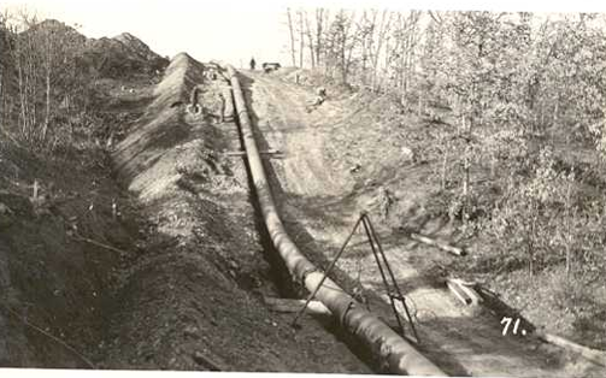
Today in Company History: Natural Gas Pipeline Company Ushers in a New Era
Posted on Wednesday, August 5, 2026
On Aug. 5, 1931, the final link of the Texas-Chicago Pipeline was laid.
The pipeline, then the longest natural gas pipeline in the world, stretched more than 900 miles and crossed 18 rivers. Ten mainline compressor stations were constructed to support the transportation of large volumes of natural gas. Continental Construction Co. was created for the sole purpose of building a pipeline system capable of transporting 175 million cubic feet of natural gas per day from the Texas Panhandle to Chicago.
At a time when most natural gas pipelines served local or regional markets, the Texas-Chicago Pipeline helped pioneer long-distance, high-pressure natural gas transmission. Its successful operation demonstrated the feasibility of transporting large volumes of natural gas across hundreds of miles, helping lay the foundation for the interstate pipeline networks that would follow.
"In the opinion of eminent engineers in the East, this is the most important construction project since the transcontinental railroads were built," a Sept. 5, 1931, Gas Age-Record article stated.
Construction of the pipeline was completed in less than a year after work began on Aug. 22, 1930. Completed during the Great Depression, the project provided much-needed jobs while helping connect growing natural gas supplies in Texas with one of the nation's largest population centers. At the time, Chicago relied heavily on manufactured gas produced from coal and oil. The Texas-Chicago Pipeline played a key role in the region’s transition from manufactured gas to cleaner-burning natural gas.
Shortly after the pipeline’s completion, Continental Construction Co. changed its name to Natural Gas Pipeline Company (NGPL).
Innovative routing techniques also contributed to the project's rapid completion. Engineers used aerial photography and mosaic maps to help determine the pipeline's route, which was influenced by factors including topography, soil conditions, river crossings, timberlands, and other physical features affecting construction costs.
In the decades that followed, the original 24-inch Texas-Chicago Pipeline, later designated the Amarillo No. 1, was expanded through the addition of parallel pipelines known as the Amarillo No. 2, Amarillo No. 3, and Amarillo No. 4 Lines. As newer pipelines were added to the corridor, portions of Amarillo No. 1 were eventually retired from service. The corridor remains an important part of NGPL's natural gas transportation system today.
Nearly a century after its completion, the Texas-Chicago Pipeline remains an important chapter in the history of interstate natural gas transportation. As one of the earliest high-pressure, long-distance natural gas pipelines, it helped usher in the modern era of interstate gas transmission. The corridor established by the project continues to serve customers today through NGPL infrastructure operated by Kinder Morgan, reflecting the enduring value of a route first envisioned more than 95 years ago.